
There is a particular moment in a growing practice when the waitlist stops feeling like a good problem. You are booked solid, you are turning families away, and you have started saying the word “assistant” out loud. The clinical side of that decision you have already handled. You know good therapy when you see it. It is everything around it that nobody prepared you for: the scheduling, the paperwork, and the supervision rules that turn out to be far more specific than you expected.
Here is the honest version of what changes when you make your first hire, so you can walk into it with your eyes open instead of learning the hard way.
First question: is it actually time?
Before any of the logistics, do the math. An assistant makes sense when the revenue from the sessions they will cover comfortably clears their pay plus the costs that hide behind it: your supervision time, onboarding, and the overhead of running two calendars instead of one.
Make it concrete. Add up the weekly sessions your waitlist would realistically fill, multiply by your rate and the weeks you actually work, then set that against the assistant’s pay, your supervision hours valued at your own rate, payroll costs, and a little onboarding time up front. If the sessions cover all of it with room to spare, you have your answer. If it only works when every hour bills and nobody ever cancels, the timing is not right yet.
The signs you are ready tend to be steady: a reliable referral stream, more demand than you can serve, and enough of a routine that you can train someone into it. The signs you are not there yet are just as clear. An unpredictable caseload, or a practice still changing shape from one month to the next. Hiring into chaos only gives you two people’s worth of chaos.
The scheduling reality
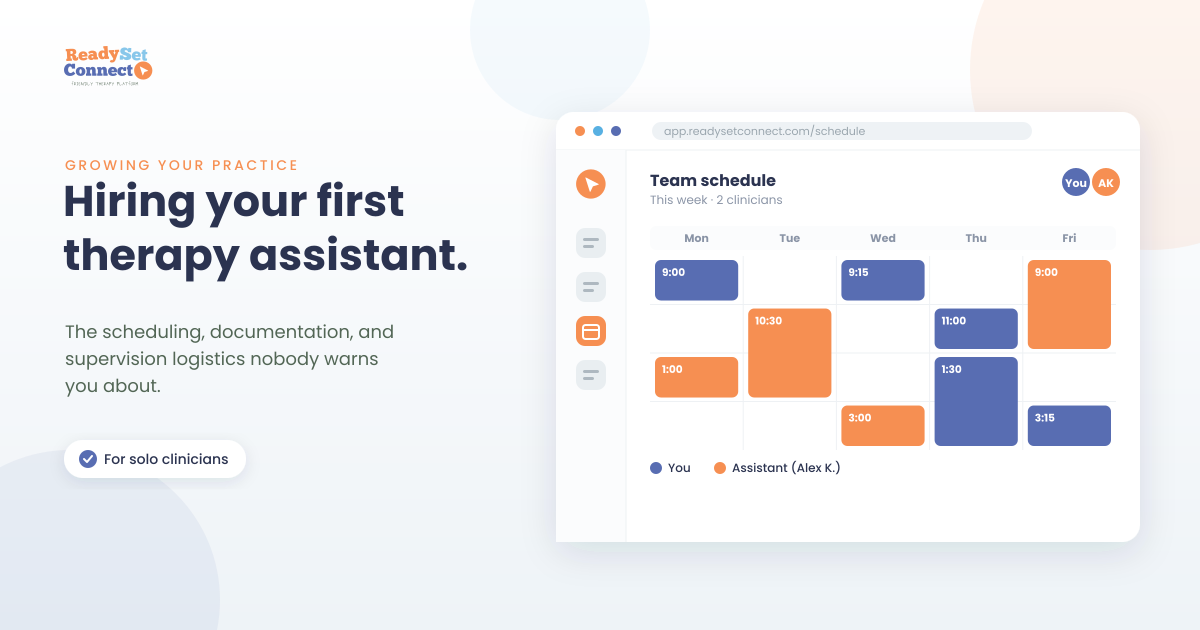
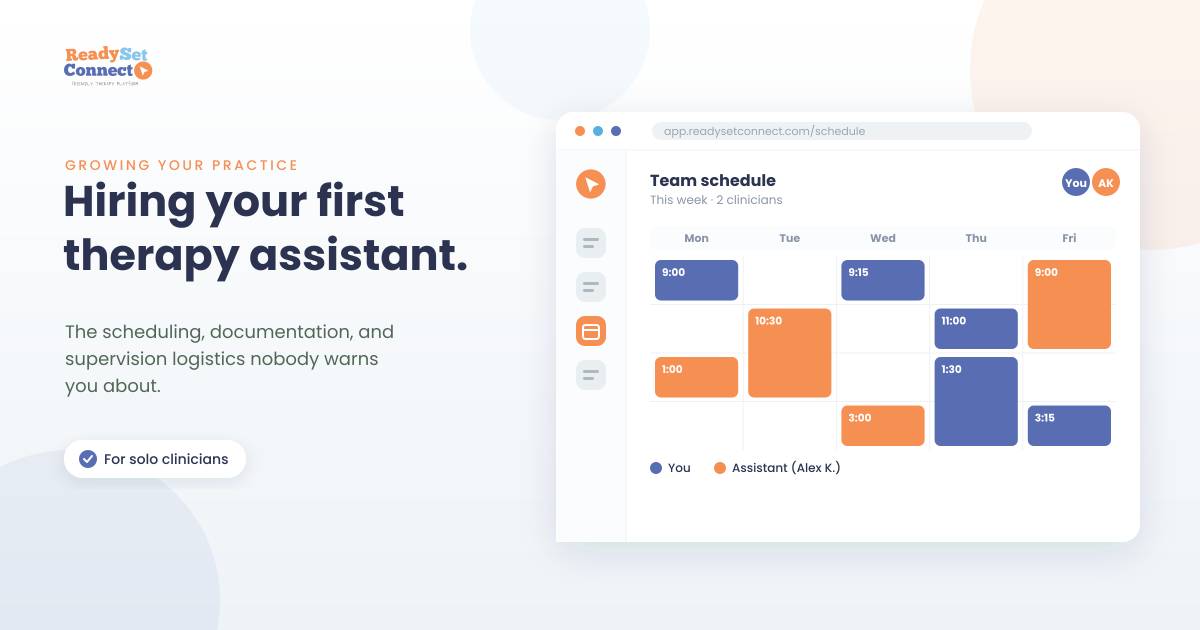
Your calendar stops being yours alone. Overnight, you are coordinating two schedules that have to lock together. You need the assistant booked only into sessions they are cleared to run, you need to be free when supervision requires it, and you need a cancellation to not leave someone sitting idle for an hour. Recurring session blocks take some of the weight off, but the real shift is in your head. You are running a schedule for a small team now, not a personal diary.
The practices that manage this well tend to standardise early. Consistent session lengths, clear rules for who covers a cancellation, and one shared calendar that both people actually trust, rather than two that quietly drift out of sync by Thursday.
The documentation shift
With one clinician, documentation is a personal habit. With two, it becomes a system. Notes are now written by more than one person, which means they have to be consistent enough that anyone reading the chart, whether that is you, a payer, or an auditor, sees the same standard every time. Depending on your discipline, state regulations, payer requirements, and practice policies, documentation may require review, approval, or co-signature. Establishing clear documentation standards ensures consistency and supports compliance. Keeping every clinician’s notes to one clear standard is what keeps that review to a quick pass instead of a weekly cleanup you grow to resent.
Put the scope of the role in writing
Assistants deliver therapy, but they do not do everything a licensed clinician does, and the line between the two is not yours to draw casually. In most disciplines, the evaluation, the plan of care, and the clinical decisions stay with the supervising clinician, while the assistant carries out treatment inside that plan. Where exactly that line sits depends on the role and on your state’s rules.
Spell it out before the first day. Which tasks the assistant owns, which stay with you, and what has to come back to you for a decision or a signature. Getting this in writing protects the client, protects the assistant from being pushed outside their scope, and protects you from the liability of blurred responsibility. It also makes the schedule and the documentation far easier to design, because everyone already knows who does what.
The supervision rules nobody warns you about
This is the part that catches most first-time employers off guard. Assistants practise under supervision, and the requirements are specific. They also vary by discipline and by state.A speech-language pathology assistant works under state licensing requirements and ASHA guidelines An occupational therapy assistant follows requirements established by state occupational therapy licensing boards, along with AOTA professional standards.A registered behavior technician follows BACB requirements along with applicable state regulations.
Each one carries its own expectations for how much supervision is required, how much of it must be direct rather than indirect, and how it has to be documented.
So the single most important thing to do before you hire is this: confirm the current requirements with your state licensing board and the national body for that role. Rules change, and what you remember from graduate school is not a safe basis for a compliance decision. Build the required supervision time into your schedule and your pricing from day one, not as an afterthought once someone is already on payroll.
Supervision also has to be documented, not just done. Licensing boards, payers, and employers may require documentation demonstrating that the required supervision occurred, including the date, duration, and format of the supervision. Maintain clear records from the beginning to support compliance. If you want the day-to-day side of that, we cover how supervision works once someone is on your team in a separate guide.
The first 30 days, in order: verify credentials and supervision requirements, set up system and calendar access, shadow sessions before any solo work, train on your documentation standard, lock in the recurring supervision schedule, then start with a light solo caseload and build from there. Work straight down the list and the first month runs on rails instead of nerves.
None of this should put you off. Your first hire is one of the clearest signs a practice is genuinely working, and the payoff is real: more families served, a second pair of hands, and room to grow past what one clinician can carry. The logistics only feel heavy the first time. Once scheduling, documentation, and supervision are in systems rather than in your memory, the second hire is far less daunting than the first.
Frequently asked questions
How do I know I am ready to hire a therapy assistant?
When you have a steady waitlist that would fill an assistant’s schedule within a month or two, a reliable referral stream, and a routine settled enough to train someone into. If the numbers only work when every hour bills and nobody cancels, wait a little longer.
What is the difference between an SLPA, a COTA, and an RBT?
They are the assistant roles in different disciplines: a speech-language pathology assistant (SLPA), a certified occupational therapy assistant (COTA), and a registered behavior technician (RBT). Each delivers treatment under a supervising clinician and follows its own national and state supervision rules.
How much supervision does a therapy assistant need?
It depends on the role and your state. Each discipline sets its own expectations for total supervision, the share that must be direct, and how it is documented. Always confirm the current numbers with your state licensing board and the relevant national body before you hire.
Can a therapy assistant write their own notes?
In many settings, assistants document the services they provide within their scope of practice. However, documentation requirements, review processes, and signature requirements vary by discipline, state regulations, and payer rules. A shared documentation standard helps maintain quality and consistency across the team.
What should I set up before my assistant’s first day?
Verify their credentials, confirm supervision requirements, set up their system and calendar access, plan shadowing before solo sessions, and put the recurring supervision schedule in place. Having these ready turns a nervous first week into a smooth one.
When you are ready to bring someone on, ReadySetConnect’s Free plan helps growing practices organize schedules, documentation workflows, and team communication as they expand.