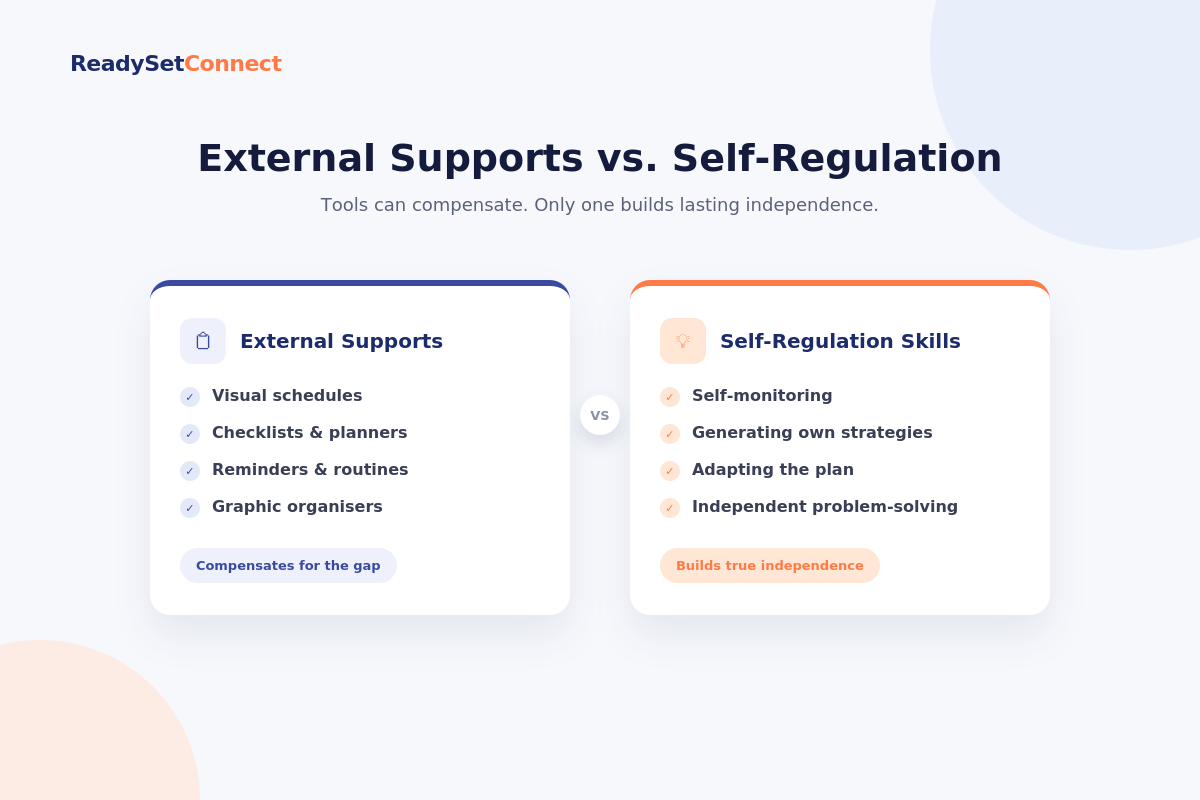
Executive function difficulties are often addressed through practical tools: visual schedules, checklists, planners, graphic organisers, reminders, and structured routines. These supports can be valuable and, for many students, necessary.
However, an important clinical question remains:
Are we using these supports only to compensate for executive function difficulties, or are we also helping students develop the underlying skills required for greater independence?
This distinction becomes particularly important when our goal extends beyond successful task completion to self-regulated performance across changing environments and demands.
Beyond the Tool
A planner can tell a student what is coming. A checklist can provide a sequence of steps. A visual schedule can make a routine more predictable.
Yet independent task execution requires considerably more.
Students need to anticipate future demands, establish goals, determine appropriate actions, initiate those actions, monitor their progress, and adapt when circumstances change.
Ward and Jacobsen (2022) emphasise the relationship between language and action across time and space, including the ability to mentally move from the present toward a desired future outcome and map the actions required to reach it.
Similarly, Meltzer et al. (2021) describe the importance of explicit strategy instruction, metacognition, and language in supporting the development of executive function.
Together, these perspectives suggest that executive function intervention should not stop at providing a strategy. Students also need opportunities to understand, practise, and increasingly self-direct the strategy.
The Gap Between Knowing and Doing
One of the challenges clinicians and educators frequently encounter is the discrepancy between what a student knows and what they are able to execute independently.
A student may know that an assignment is due tomorrow, yet fail to anticipate the materials, time, or sequence of actions required to complete it.
They may understand a classroom routine, yet struggle when the routine changes.
They may know what they are “supposed” to do, but have difficulty determining what to do when the expected solution is no longer available.
This gap between knowledge and action is central to functional executive functioning.
And it raises a broader question:
Can the student generate the executive process, or are we continually providing it for them?
The Role of Language and Inner Speech
Language provides another important pathway for supporting executive control.
Baron and Arbel (2022) discuss the relationship between inner speech and executive function, highlighting how self-directed language may support children’s ability to organise thought and behaviour, understand task rules, sequence actions, and maintain goals.
In practice, this can mean moving from adult-directed prompts such as:
“What do you need to do next?”
toward helping students develop their own internal prompts:
- “What is my goal?”
- “What do I need?”
- “What comes first?”
- “Is this working?”
- “What can I change?”
The long-term objective is not for adults to provide increasingly sophisticated prompts.
It is for students to increasingly generate the questions themselves.
Independence Requires Flexibility
Planning alone is not sufficient.
Students also need to recognise what a situation requires and adjust their behaviour when circumstances change. This requires cognitive flexibility, situational awareness, and problem-solving.
A plan may need to change because the environment changes, information is incomplete, a task takes longer than expected, or an anticipated solution is unavailable.
Independence, therefore, should not be defined simply as following a plan correctly.
A more functional definition may be the ability to create, implement, monitor, and modify a plan in response to changing demands.
This is particularly relevant when executive function skills need to generalise across classrooms, therapy sessions, home routines, community environments, and eventually employment.
A Shift in Intervention Thinking
This perspective invites a subtle but important change in clinical reasoning.
Instead of asking only:
“What support does this student need?”
we can also ask:
“What executive process does this student need to develop?”
- Does the student need to strengthen future-oriented thinking?
- Are they having difficulty translating language into action?
- Do they need explicit instruction in planning?
- Can they recognise contextual cues?
- Can they identify when a strategy is no longer working?
- Can they generate an alternative?
- Can they monitor their own performance?
And perhaps most importantly:
What level of adult support is necessary now, and how can that support be systematically reduced over time?
These questions shift intervention from managing performance toward developing self-regulation.
From Adult-Managed to Increasingly Self-Regulated
This is an area I am particularly interested in at the intersection of occupational therapy and cognitive neuropsychology.
The ultimate objective is not necessarily independence without support. Rather, it is greater independence with ownership of the strategies and processes that support performance.
This may mean a student learns not only to use a planner, but to recognise when planning is necessary.
Not only to follow a schedule, but to anticipate what comes next.
Not only to complete a task, but to determine the steps required.
Not only to follow Plan A, but to recognise when Plan B is necessary.
That is a meaningful shift from external management toward self-regulation.
Continuing the Conversation
With the new school year beginning, this conversation is particularly timely. New routines, expectations, transitions, and academic demands create opportunities to consider not only what supports students need, but which executive function skills we want them to develop.
On September 10, Sarah Ward, M.S., CCC/SLP, will lead our live course, Practical Strategies to Develop Independent Executive Function Skills.
With more than 25 years of experience in executive dysfunction and presentations to more than 2,000 schools and organisations internationally, Sarah is an internationally recognised expert in executive function. Her work focuses on practical approaches that help students move from adult-managed executive functioning toward greater self-regulation.
The course will explore practical applications of visual forethought, cognitive flexibility, situational awareness, and authentic task planning, with an emphasis on translating executive function theory into functional practice.
Designed for clinicians and educators seeking to expand their understanding of executive function, the course will focus on evidence-informed strategies that support student independence across settings.
For those working with students with executive function challenges, this is an opportunity to move beyond simply identifying the difficulty and consider how we can deliberately develop the underlying processes that support greater independence in academic and everyday life.
I look forward to learning from Sarah and continuing this important conversation with colleagues across occupational therapy, speech-language pathology, education, and related fields. Visit our profile to register for the course.
References
Baron, L. S., & Arbel, Y. (2022). Inner speech and executive function in children with developmental language disorder: Implications for assessment and intervention. Perspectives of the ASHA Special Interest Groups, 7(6), 1645–1659. https://doi.org/10.1044/2022_PERSP-22-00042
Meltzer, L., Greschler, M. A., Davis, K., & Vanderberg, C. (2021). Executive function, metacognition, and language: Promoting student success with explicit strategy instruction. Perspectives of the ASHA Special Interest Groups, 6(6), 1343–1356. https://doi.org/10.1044/2021_PERSP-21-00034
Ward, S., & Jacobsen, K. (2022). Mapping language to actions and movement across time and space: New strategies for promoting successful task execution. Perspectives of the ASHA Special Interest Groups, 7(5), 1284–1300. https://doi.org/10.1044/2022_PERSP-21-00105
| Ready to Help Students Build Real Independence?
Join Sarah Ward, M.S., CCC/SLP, on September 10 for the live course Practical Strategies to Develop Independent Executive Function Skills — and learn how to move students from adult-managed support toward genuine self-regulation. Register Now → https://readysetconnect.com/education-webinar |