Picture a fourth grader with a checklist in his folder, a colour-coded planner, and a visual schedule on his desk. Ask him what he needed to bring today, or what to do first, and he can’t tell you.
The tools aren’t the problem. They assume he can already picture “finished,” hold onto it, and work back from it. If he can’t yet, the system is thinking for him, and the adult running it has become part of his executive function.
That’s where a lot of executive function work stalls. Let’s look at which skills to target, how to teach them with real tasks, how to measure independence, and how to hand the work over to teachers and families.
What are executive function strategies for students?
Executive function strategies for students help them get better at previewing, planning, starting, adjusting, and finishing tasks on their own, instead of relying on a structure that does it for them.
Two things often get lumped together:
- Compensatory supports make a task easier: checklists, written steps, adult-set timers, pre-organised materials. They get the student through today.
- Capacity-building interventions build what the student can do alone, like making their own steps, estimating time, and catching mistakes. They get the student through next month.
A plan of care needs both. If you only use supports, progress lasts only as long as the support does.
A good first question: if this tool vanished tomorrow, would the student have learned anything they can use elsewhere?
Why checklists and planners often stall
Here’s the catch. Most supports rely on the very skill they’re meant to help. A checklist hands over a sequence, but building that sequence is the real skill. A planner expects kids to estimate time and care about a deadline that feels far off. A visual schedule shows what’s next, but rarely what “done” looks like. A graphic organiser assumes they can keep the end goal in mind.
So keep using them. Just know what each one is doing, and make sure at least one goal works on the skill underneath.
Where this comes from: this idea sits at the heart of ReadySetConnect’s one-hour CEU, Practical Strategies to Develop Independent Executive Function Skills, taught by Sarah Ward, M.S., CCC/SLP. If you’ve ever wondered whether you helped a student or just did the task for them, this course is for you.
Four capacities to target before you add another tool
Visual forethought
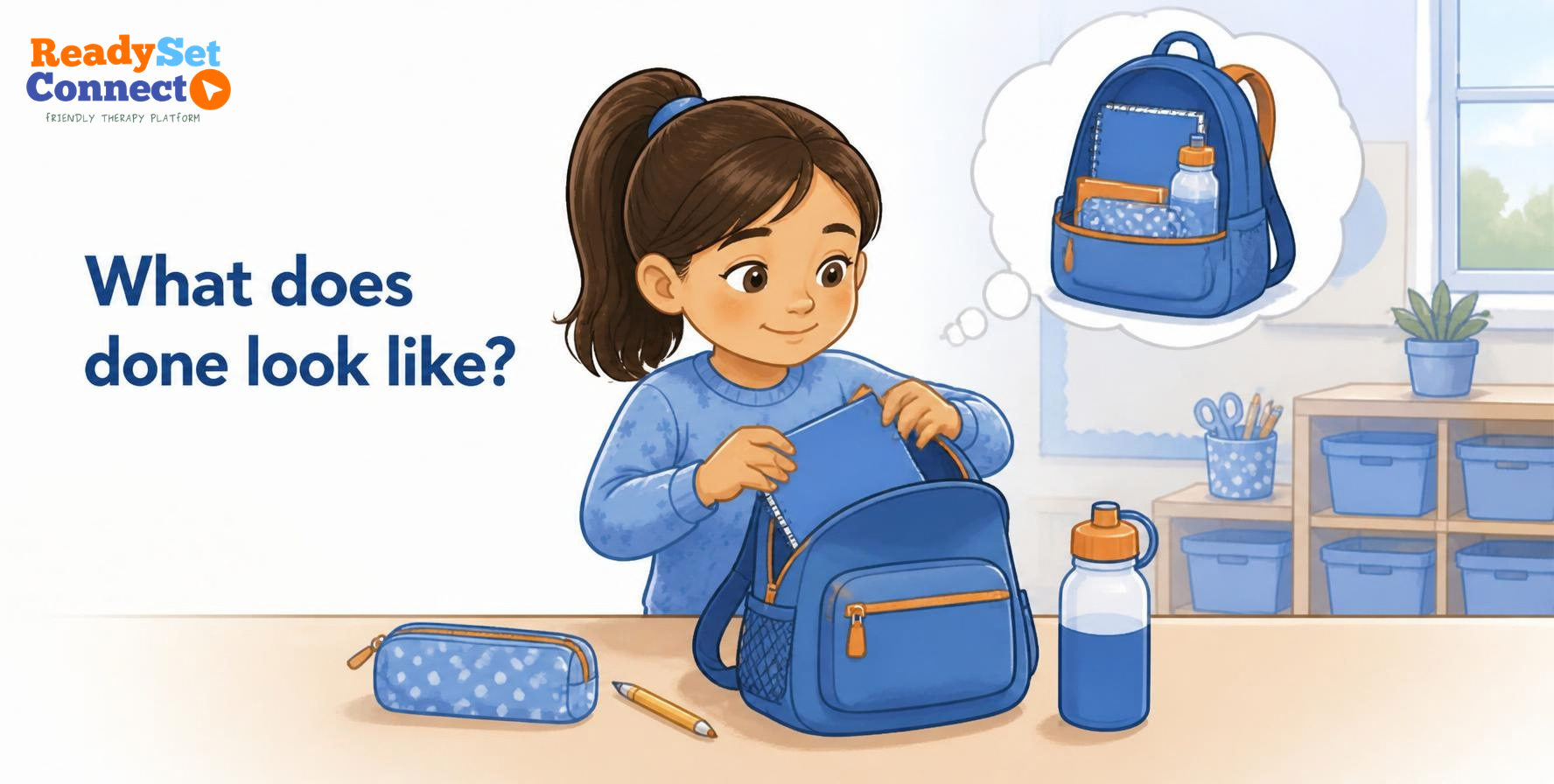
Visual forethought is picturing the finished task, and yourself doing it, before you start. Kids who can’t do this tend to grab whatever’s closest.
In session:
- Before any instructions, ask, “Show me what done looks like.” Let them draw, describe, or photograph it.
- Swap the step list for a photo of the finished product, and let the student figure out the steps.
- Add future-self questions: “You’re at the classroom door at 3:10. What’s in your hands?”
- Try video self-modelling so they see themselves doing it well.
Cognitive flexibility
Cognitive flexibility is changing your approach when things change, without the plan falling apart. You’ll spot the struggle when a student gets upset over a changed routine, or keeps repeating something that didn’t work.
In session:
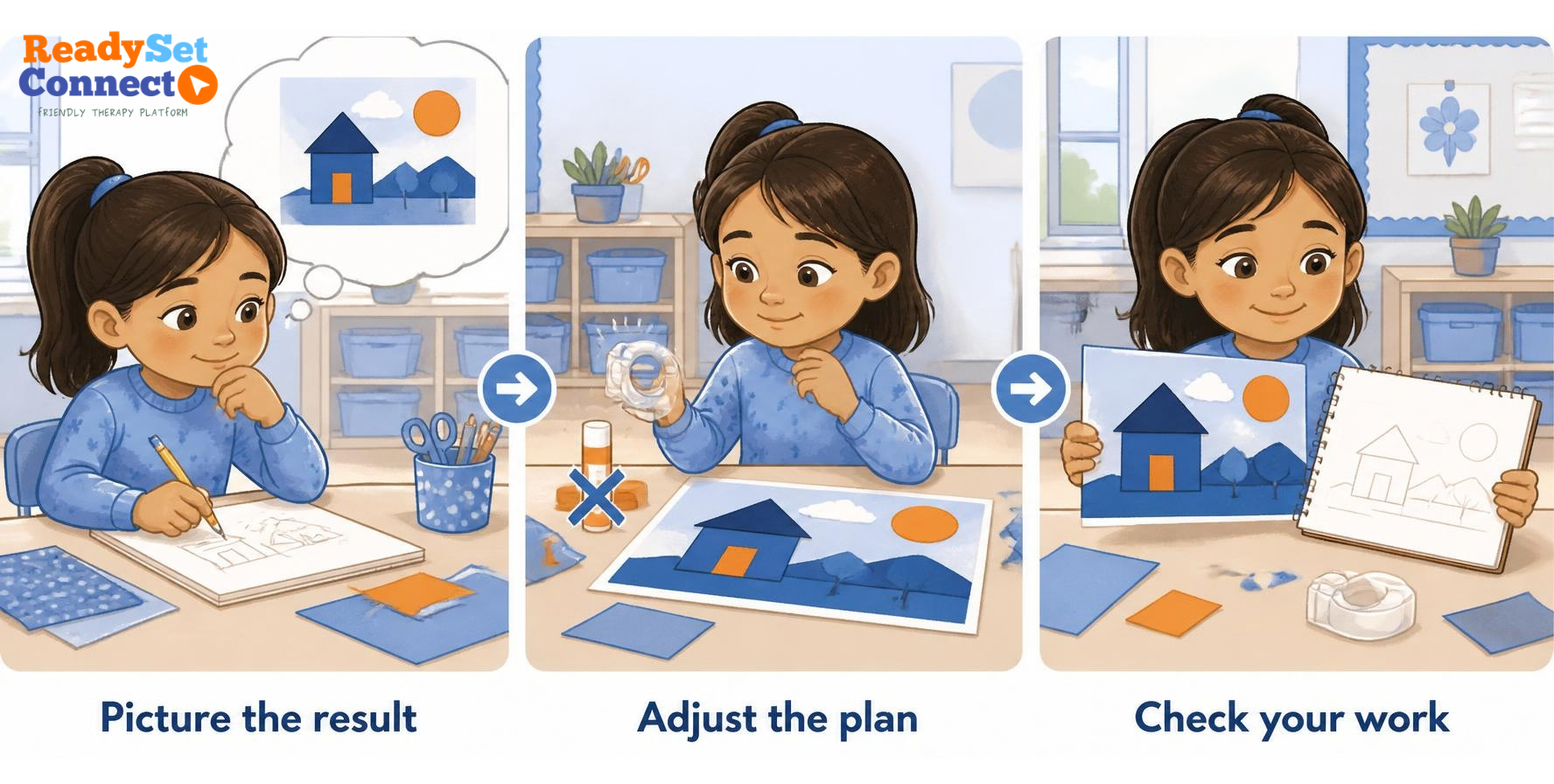
- Build one planned change into each activity, like a missing material, a new order, or less time.
- Talk through “what ifs” first. What if the glue’s dried out? What if the printer’s busy?
- Ask for two plans, then have them pick one and say why.
- Sort the same materials in different ways to loosen rigid thinking.
Situational awareness
Situational awareness is reading what’s going on and adjusting. A student can know a rule well and still miss that it applies right now.
In session:
- Show a photo of a classroom or hallway and ask what’s happening, what’s expected, and what someone should be doing.
- Teach a quick room check: Where am I? What time is it? What’s everyone doing? What should I be doing?
- Then get them to name their own next step. Most kids skip that part.
Authentic task planning
Authentic task planning means working backwards from the finished picture, then doing the task, using things the student actually cares about.
In session:
- Start with the result, then the steps, then the materials. It’s the opposite of how we usually teach.
- Use real tasks, like packing a bag, making a snack for two, or gathering supplies for a class project.
- Have them guess how long it’ll take, time it, and talk about the difference. That gap is where the learning is, not a failure.
- Let them collect their own materials. If something’s missing, let them find out.
From adult prompts to student self-talk
Language is one of the main ways students organise their thinking. Self-directed language helps them make sense of rules, sequence actions and hold onto a goal (Baron & Arbel, 2022), so the prompts you use matter as much as the tools.
Adults often start with “What do you need to do next?” The aim is for that question to move inside the student. Over time, coach them toward asking themselves:
- What is my goal?
- What comes first?
- Is this working?
- What can I change?
Model the questions out loud first. Then fade your prompt from a full question to a short cue, and then to wait time alone. For more on why this shift matters, read our article, Executive Function Skills: From External Supports to Self-Regulation and Independence.
A five-step session structure you can use this week
- Choose an authentic task. Pick something with a real end point the student cares about. Made-up worksheets rarely carry over.
- Establish the image of done. Have the student describe, draw, or photograph the result before talking steps.
- Plan backwards, then forwards. They come up with the steps. You write them down.
- Introduce one disruption. Change one thing and let them adjust the plan instead of starting over.
- Review against the image, not against your prompts. What matched? What didn’t? What would they change next time?
When time runs short, the review is the first thing to go. But it’s what turns an activity into a strategy the student owns.
Executive function skills for kids: what to notice at different stages
Executive function skills for kids develop slowly and unevenly, and the same problem looks different at each age.
- Early elementary: struggles with two-step directions, starts with whatever’s nearest, has little sense of time.
- Late elementary: follows steps but can’t create them, packs the wrong things, loses finished work before handing it in.
- Middle school: planning gets much harder as adults step back, and multi-day projects expose trouble with timing and getting started.
- High school and transition: the challenge shifts to juggling lots of commitments.
Before blaming executive function, rule out language, reading level, regulation and sensory needs, motor demands, or an unfamiliar task. These often overlap; one observation isn’t a diagnosis, and sorting it out is the assessing team’s job.
Independent learning strategies for students that transfer beyond your session
Independent learning strategies for students only stick when teachers and parents stop thinking about them. That makes the handover just as important as the therapy.
What helps:
- Give the team one shared phrase. If you say “What does done look like?”, teachers and parents should too. Same words matter more than same tools.
- Name who holds the image. Agree on when the adult provides the finished picture and when the student does, and set a date to switch.
- Shift the type of prompt, not just the amount. Go from telling, to asking, to gesturing, to waiting.
- Protect the wait. Adults often jump in too soon. Waiting a bit longer is free and it works.
- Send home one routine, not a system. One task the family already does beats a new system nobody keeps up.
With a full caseload, keeping goals and prompt data in one place makes handovers far easier. ReadySetConnect’s progress tracking and reporting tools are built for this.
Measuring self-management, not compliance
Most executive function goals are really about self-management, but it’s easy to write goals that just measure whether the task got done.
Write the goal around the plan, not the product. Counting finished worksheets measures adult help. Counting steps the student came up with measures the skill.
Use prompt-level data. Note the least support the student needed: independent, wait time, indirect cue, direct cue, gesture, or model. Moving from direct to indirect cues is progress, even if accuracy stays the same.
Sample goals to adapt:
- Given an authentic classroom task, the student will describe the finished outcome and generate at least four ordered steps with no more than one indirect cue, across three consecutive sessions.
- Given an unexpected change to a familiar routine, the student will state a revised plan within 60 seconds with wait time alone, in four of five opportunities.
- Given a task with a stated time limit, the student will estimate duration before starting and compare estimate to actual, independently, across three consecutive sessions.
Track the trend in independence. Chart prompt levels next to accuracy. If accuracy is high but prompts aren’t dropping, the support is doing the work.
Executive functioning professional development: what to look for
Not every executive functioning professional development course changes how you work. Look for:
- A stated framework, not just a pile of activities that are hard to adapt.
- Explicit treatment of the compensatory-versus-capacity distinction. A course that only gives you tools won’t fix the problem we started with.
- Applied examples from real sessions, including what to do when something doesn’t work.
- Accreditation that counts for your licence. For OTs and SLPs, that usually means an AOTA-approved provider and ASHA CEUs, though states vary. Our guide to what counts toward licence renewal explains more.
- A realistic time commitment. A focused hour you finish beats a twelve-hour course you never complete.
ReadySetConnect’s CEU course library is built around this standard, with courses designed for occupational therapists, speech-language pathologists, and special education teams.
Do you need an executive function coaching certification?
An executive function coaching certification is a longer credential, often weeks or months, for people offering coaching as its own service. It’s worth it if coaching is becoming your specialty.
For most OTs, SLPs, and educators, it’s not the place to start. Executive function is already in your scope, and a certification won’t change that. A clear framework you can use on Monday matters more. Try this order:
- Take a focused CEU with a framework you can use in session.
- Apply it to three students and track prompt levels for six to eight weeks.
- Decide from there whether your caseload calls for a longer certification.
Common misconceptions worth correcting
“It will develop with maturity.” It does keep developing into early adulthood, but demands often grow faster, and the gap widens in middle school. Waiting isn’t a plan.
“It is a motivation problem.” If a student can tell you what they should have done and still didn’t, the issue is usually doing, not knowing or wanting.
“Brain-training games will transfer.” Getting better at a game mostly makes you better at the game. Real tasks are the safer bet.
“This is only relevant for ADHD.” These demands show up across many profiles, often in students referred for something else.
Frequently asked questions
What’s the difference between self-management and finishing a task?
A task can get done with lots of adult help. Self-management means the student started, checked, and adjusted their own work. Prompt-level data shows which one you’re seeing.
At what age should executive function skills for kids be addressed?
Sequencing, anticipating, and estimating can be built from early elementary through daily routines. There’s no set age. Base targets on what the student’s environment asks of them now.
Does this ReadySetConnect course offer CEUs?
Yes, 0.1 CEUs. ReadySetConnect is an AOTA Approved Provider (PD activity approval ID #117022), and ASHA CEUs apply where relevant. You’ll need to attend the full session and score 80% on a five-question quiz.
Where to go from here
If a student came to mind while reading, try this in your next session. Pick one real task, get the picture of “done” first, and note the least support they needed. That one note will tell you more than a term of worksheets.
Want the full framework? Practical Strategies to Develop Independent Executive Function Skills is a one-hour, AOTA- and ASHA-accredited course (0.1 CEUs) with Sarah Ward, M.S., CCC/SLP, who has 25+ years in executive dysfunction and co-created the 360 Thinking Executive Function Program. No prerequisites, and you get five years of access.