Your child’s IEP meeting is scheduled. You have a packet of paperwork, a room full of school staff, and roughly an hour.
For most parents, the first meeting is disorienting. The acronyms arrive quickly. The documents are written for compliance rather than for families. And the meeting often ends with a signature request before you have fully processed what was discussed.
This guide explains what actually happens in that room, in plain language. It will not make you an expert in special education law. It should make you a more confident participant.
First, what an IEP actually is
An IEP – an Individualized Education Program – is a written, legally binding plan for a student who qualifies for special education services under federal law.
Two parts of that definition matter most.
It is individualized. The plan describes your child specifically: present levels of performance, annual goals, the services the school will provide, and how progress will be measured.
It is binding. Once signed, the services listed are a commitment, not an aspiration. If the document says 60 minutes of speech therapy per week, the school owes 60 minutes of speech therapy per week.
This is why the paperwork is worth reading carefully. The document, not the conversation, is what the school is held to.
IEP vs 504 plan: the difference in one paragraph
Parents are often told their child “has a 504” or “qualifies for an IEP” without anyone explaining the distinction.
A 504 plan provides accommodations so a student can access the general curriculum – extended time on tests, preferential seating, a modified schedule. It changes how a student learns.
An IEP provides specialized instruction and related services, such as speech-language therapy or occupational therapy, delivered by qualified staff. It changes what and how a student is taught, and it comes with far more procedural protection for families.
Put simply: a 504 plan removes barriers. An IEP delivers services. A student who needs direct therapy or specially designed instruction generally needs an IEP.
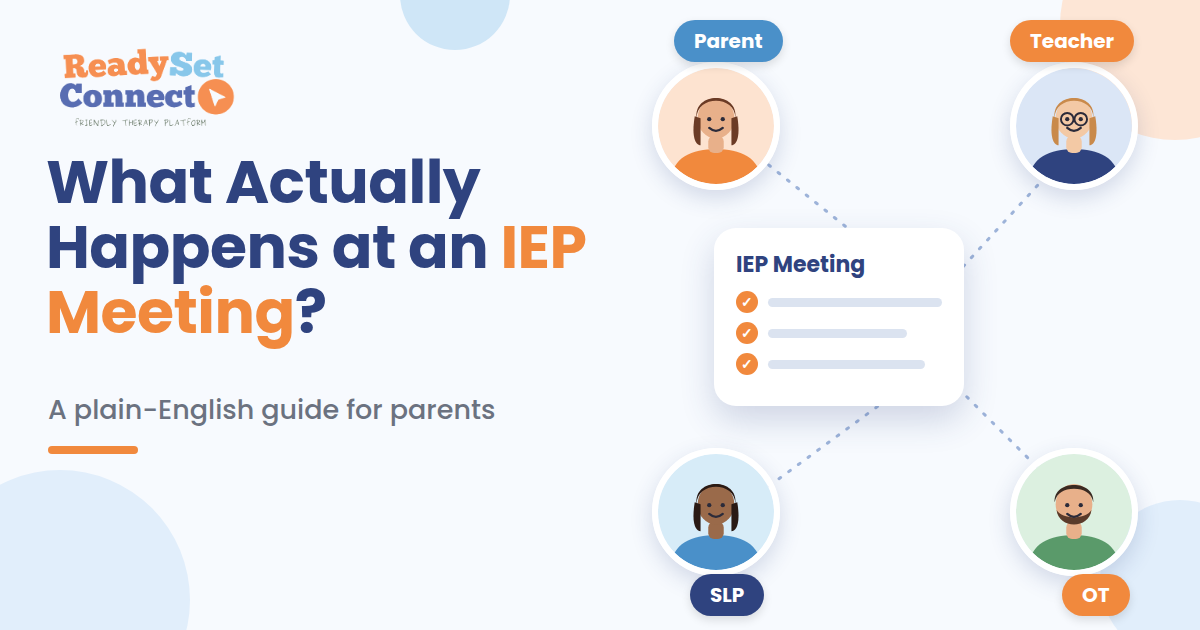
Who attends an IEP meeting
Federal law specifies who must be in the room. Knowing each role in advance makes the meeting far less intimidating.
- You, the parent or guardian. You are a full member of the team, with equal standing. This is not a briefing you attend; it is a decision you participate in.
- A general education teacher, if your child spends any time in a general education setting.
- A special education teacher or provider, who typically drafts the goals.
- A district representative, someone able to commit school resources – often an administrator or special education coordinator.
- Someone who can interpret evaluation results, usually the school psychologist or an evaluator.
- Related service providers, such as a speech-language pathologist or occupational therapist, when those services are on the table.
- Your child, when appropriate – required from age 16 in most states, once transition planning begins.
You may also bring anyone you choose: a spouse, a friend who takes notes, a private therapist, or an advocate. You do not need permission, though it is courteous to let the school know in advance.
What happens, in order
Most IEP meetings follow the same sequence. Expect roughly this:
- Introductions and purpose. Everyone states their name and role. The team confirms whether this is an initial IEP, an annual review, or a re-evaluation.
- Present levels of performance. The team describes how your child is currently doing — academically, socially, and functionally. This section draws on evaluations, classroom data, and therapy data.
- Discussion of eligibility, if relevant. For an initial meeting, the team confirms whether your child qualifies under one of the federal disability categories.
- Goals. The team proposes annual goals. Each should be specific and measurable, with a stated method of tracking progress.
- Services and placement. The team specifies the services, the minutes, the setting, and the accommodations. This is the most consequential section of the meeting.
- Signatures. The school asks you to sign.
That last step is where parents most often feel rushed.
How to prepare for an IEP meeting
Preparation changes the meeting more than anything you say during it.
Request the draft in advance. Ask for the draft IEP and any evaluation reports at least a few days before the meeting. Schools routinely prepare a draft; you are entitled to read it first. Reviewing it at the table puts you at a disadvantage.
Write down what you see at home. Teachers observe your child for six hours in a structured setting. You observe everything else. Homework that takes three hours, meltdowns after school, a skill that appears at home but not at school – these are data the team does not otherwise have.
Bring your own short list of priorities. Two or three, in order. Meetings drift, and a written list keeps your concerns from being crowded out.
Ask for an interpreter or accessible materials if you need them. The school is required to provide them.
Questions to ask at an IEP meeting
The following questions consistently surface information that would otherwise stay unsaid.
On goals: “How will progress on this goal be measured, and how often will I see the data?” A goal without a measurement method is difficult to enforce.
On services: “Are these minutes direct or consultative, and are they individual or group?” Thirty minutes of individual speech therapy and thirty minutes in a group of five are very different services.
On placement: “What does a typical day look like for my child under this plan?” This converts abstract language into something you can picture.
On staffing: “Who will deliver these services, and what happens if that position is vacant?” Staffing shortages are common, and the answer tells you how the school handles them.
On progress: “What will you do if my child is not making progress toward these goals?” A team that has thought this through will have an answer.
The three things to check before you sign
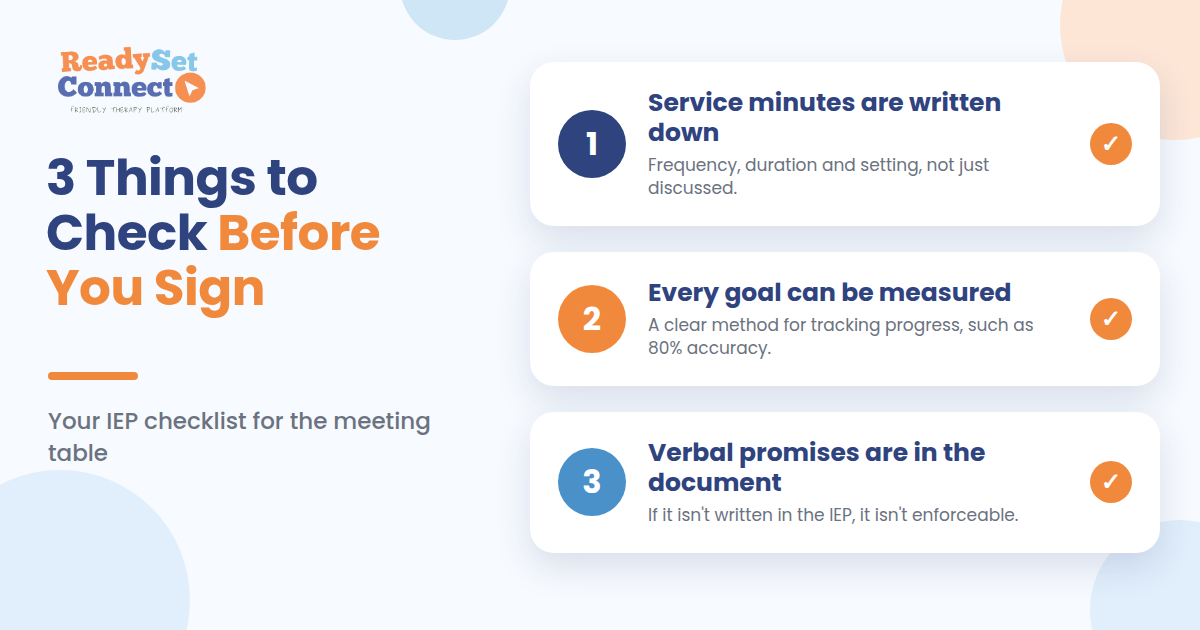
Before signing, confirm these three items explicitly.
- The service minutes are written down and not discussed – written, with frequency, duration, and setting.
- Every goal has a measurement method. “Will improve articulation” is not measurable. “Will produce /r/ in conversation with 80% accuracy across three sessions” is.
- Everything you agreed to verbally appears in the document. Verbal assurances are not enforceable.
And one thing worth knowing: you are not required to sign at the table. You may take the document home, read it, and return it. In many states, your signature indicates consent to the services, which means you can consent to part of the plan while formally noting disagreement with another part. Ask the team how that is documented in your district.
Requesting time to review is a normal, reasonable step — not an act of conflict.
Where speech and OT services fit in
If your child receives speech-language or occupational therapy at school, those services appear in the IEP as related services, with their own goals and minutes.
The professionals delivering them — the speech-language pathologists and occupational therapists on your child’s team — track session-by-session data against those goals. So do the special education teachers coordinating the plan.
That data is available to you. If you would like to see progress more often than the scheduled reporting periods, ask for it. Most providers are glad to share it, and a short monthly update is usually easier to arrange than parents expect.
The meeting is a conversation, not a verdict
An IEP is a working document. It can be amended. You can request a meeting at any point during the year if the plan is not serving your child.
Walking in with the draft read, your priorities written down, and three or four questions ready changes the dynamic considerably. You are not there to approve a decision. You are there to help make one.
Frequently asked questions about IEP meetings
How long does an IEP meeting usually last?
Most annual reviews run 45 to 90 minutes. Initial eligibility meetings often take longer because the team reviews evaluation results in detail. If the time runs out before your concerns are addressed, you can ask to reconvene rather than rush the remaining items.
Can I record the meeting?
Rules vary by state and district. Some allow it with advance notice; others restrict it. Ask the school in writing before the meeting so the answer is documented.
What if I disagree with the IEP?
You can consent to the parts you agree with and note your disagreement with the rest. From there, options include requesting another meeting, asking for an independent educational evaluation, mediation, or a due process complaint. Start with a written request for a follow-up meeting — most disagreements are resolved there.
How often is the IEP reviewed?
At least once a year. A full re-evaluation happens at least every three years. You may request a review meeting at any point if the plan is not working.
Can services be changed mid-year?
Yes. The IEP is amendable. Changes require a team meeting, or in some districts, a written amendment agreed to by you and the school.
Does my child have to attend?
Not usually in the early years. Once transition planning begins — age 16 in most states — your child is invited and encouraged to participate.