Clinical documentation is an essential part of therapy, but it can also be one of the most time-consuming. Writing session notes after a full day of treating clients can mean staying late, catching up between sessions, or trying to recall important details from memory. Yet accurate, timely documentation is vital for continuity of care, clinical decision-making, reimbursement, and professional accountability.
AI-assisted session notes are increasingly being presented as a way to reduce this burden. But what can AI actually do, and how much clinical work still depends on the therapist?
This article explores how AI-assisted session notes work in ReadySetConnect, how they can support clinical documentation, and why the therapist’s clinical judgment remains essential.
What “AI-Powered” Should Mean in Clinical Documentation
Writing a SOAP note involves more than putting information into sentences. Some tasks are administrative, such as organizing session details, structuring information, and formatting the note. Others require clinical expertise: interpreting a client’s performance, evaluating progress toward goals, and determining appropriate next steps in treatment.
AI can help streamline the documentation process, but it cannot take responsibility for clinical decisions. As ASHA’s guidance on generative AI emphasizes, clinicians must review AI-assisted documentation for accuracy and ensure it meets applicable legal, ethical, and payer requirements. Professional judgment remains the clinician’s responsibility.
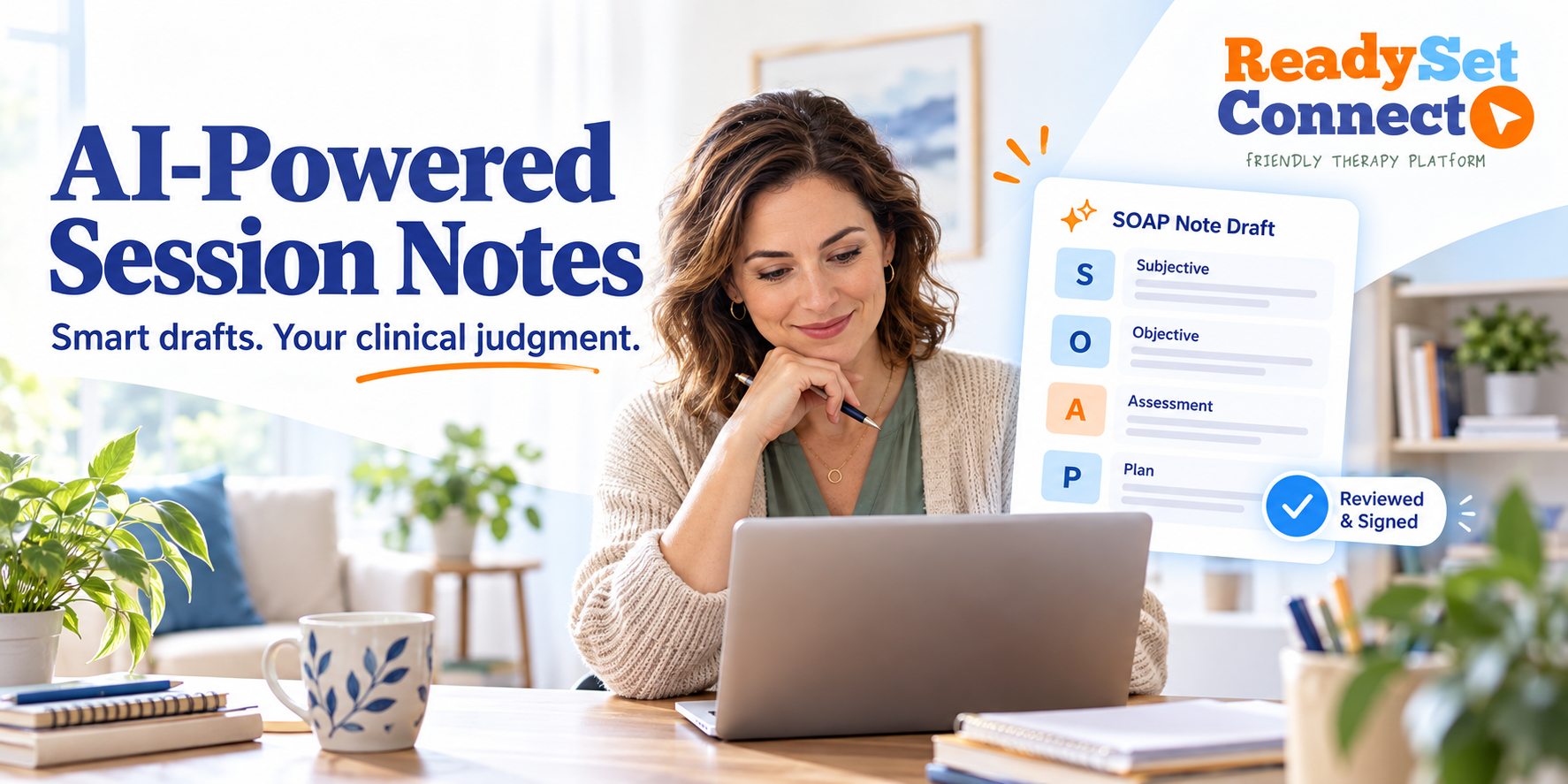
ReadySetConnect’s AI-assisted session notes are designed to support the documentation process while keeping the therapist in control of the final clinical record.
How AI-Assisted Session Notes Work in ReadySetConnect
ReadySetConnect’s AI-assisted session notes are part of its documentation and SOAP notes tools and are included in the Essential plan.
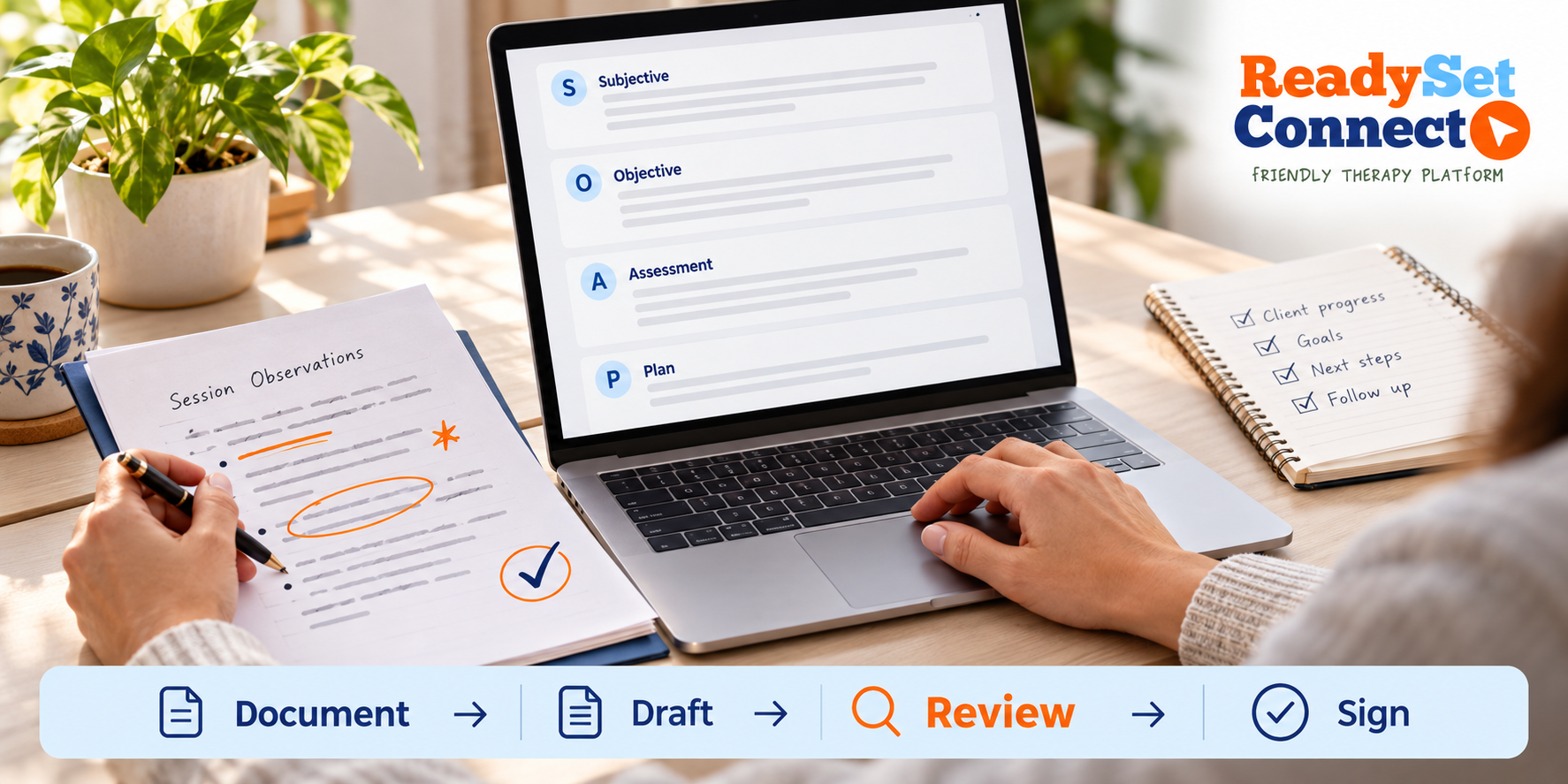
The workflow follows four steps:
- Document the session. Enter the relevant session information, including the goals addressed, activities completed, and the client’s performance.
- Generate a draft. The AI uses the information provided to organize the content into a SOAP note, structured under Subjective, Objective, Assessment, and Plan.
- Review and edit. Check the draft for accuracy, make corrections, and ensure the clinical observations, interpretation, and next steps reflect your professional judgment.
- Sign the note. Once you have reviewed the content and confirmed that it accurately represents the session, sign the note.
The AI-generated draft is a starting point, not a substitute for clinical review. It can organize the information you provide, but it cannot independently verify what happened during a session or replace your clinical reasoning. The more accurate and complete your initial documentation, the more useful the draft is likely to be.
What to Document for a Better AI-Generated Note
The quality of an AI-generated SOAP note depends on the information you enter during the session. A few simple documentation habits can help you get a more accurate and useful draft.
- Connect observations to treatment goals. Note which goals you worked on and how the client performed during each activity.
- Document the level of assistance. Record the cues, prompts, or physical assistance the client needed to complete a task.
- Describe the client’s response. Include relevant observations about attention, engagement, fatigue, sensory regulation, or participation during the session.
- Include caregiver updates. Document relevant information shared by caregivers about the client’s progress, behavior, or performance at home.
Clear, specific session notes give the AI better information to work with. This makes the draft easier to review and edit before you finalize your clinical documentation.
What the Feature Automates
AI-assisted session notes can reduce the repetitive work involved in writing SOAP notes, helping therapists organize session information and turn it into clear, structured documentation. However, the therapist remains responsible for the accuracy and clinical content of the final note.
| SOAP section | What AI helps with | What the therapist needs to do |
|---|---|---|
| Subjective | Organizes information reported by the client or caregiver | Checks that the report is accurate and complete |
| Objective | Structures information about treatment goals, activities, and client performance | Verifies the recorded data, measurements, and level of assistance |
| Assessment | Helps organize a summary of the client’s performance | Interprets progress, identifies clinical significance, and explains the need for skilled intervention |
| Plan | Helps structure documentation of next steps | Determines treatment goals, interventions, frequency, and home recommendations |
In short, ReadySetConnect’s AI-assisted SOAP notes help therapists organize information and improve the wording of their documentation. Clinical interpretation, treatment decisions, and approval of the final note remain the therapist’s responsibility.
What It Does Not Automate
AI can help with documentation, but some parts of clinical practice must remain in the therapist’s hands.
- Clinical judgment. Determining whether a client is making progress, has reached a plateau, or is ready for a new treatment goal requires clinical reasoning and an understanding of the client’s needs.
- Accuracy. AI-generated notes may contain errors in percentages, number of trials, levels of assistance, or other session details. Always check the draft against your actual session data.
- Individualized documentation. Each note should reflect the specific client, the session, and the progress made toward treatment goals. As ASHA’s documentation guidance emphasizes, clinical documentation should accurately represent the individual’s needs and services provided.
- Justification for skilled services. Notes should explain why the intervention was appropriate, what clinical expertise was required, and how the session addressed the client’s needs. AI can help organize the information, but the clinical reasoning must come from the treating therapist.
- Professional accountability. Before signing a note, the therapist must ensure it is accurate, complete, and appropriate for the client’s record. Using AI does not transfer responsibility for the final documentation to the software.
A Five-Point Review Before You Sign an AI-Generated SOAP Note
Before signing an AI-generated SOAP note, take a moment to check these five things.
- Data: Do the numbers, measurements, and levels of assistance match your session records?
- Accuracy: Does the Subjective section accurately reflect what the client or caregiver reported?
- Clinical reasoning: Does the Assessment reflect your interpretation of the client’s performance and progress toward treatment goals?
- Skilled intervention: Does the note explain what you did, why it was clinically appropriate, and how it addressed the client’s needs?
- Individualization: Does the note reflect this client’s performance and this specific session, rather than repeating generic wording from previous notes?
Reviewing these details helps ensure that the final note accurately represents the session, supports continuity of care, and reflects your professional judgment. AI can help prepare the draft, but you are responsible for the note you sign.
Where the Time Is Actually Saved
AI-assisted documentation can reduce the time spent writing notes, but it does not eliminate the need for clinical reasoning or review. The main benefit is having a structured draft to work from instead of starting from scratch.
- A starting point for every note. Reviewing and editing a draft can be easier than writing the entire note from a blank page.
- Less repetitive writing. Routine descriptions of activities, goals, and session information may require less manual typing.
Reviewing the note remains essential. Completing documentation while the session is still fresh can also make it easier to verify details and correct errors. AI is a tool to support documentation, not a shortcut around reviewing and signing your notes.
Considerations for Speech Therapy and Occupational Therapy
Different therapy disciplines require different details in clinical documentation. AI-generated drafts should be reviewed to ensure they accurately reflect the interventions provided and the client’s performance.
- Speech-language pathology: Check target sounds, language skills, cueing levels, accuracy across trials, and whether responses were independent or prompted.
- Occupational therapy: Check levels of assistance, performance in daily activities, progress toward functional goals, and descriptions of sensory processing, motor skills, and participation.
Frequently Asked Questions
Does AI write the entire session note?
No. ReadySetConnect generates a draft based on the session information you enter. You review and edit the note to ensure it accurately reflects the session before signing it.
Will payers accept AI-assisted session notes?
AI-assisted notes must meet the same documentation requirements as other clinical notes. Payer requirements vary, but notes should accurately reflect the services provided, the client’s progress, and the medical necessity of treatment when required. Using AI does not replace your responsibility to ensure the note meets applicable requirements.
Which ReadySetConnect plans include AI-assisted session notes?
Visit the ReadySetConnect pricing page to compare available plans and features.
Keeping Clinical Documentation in the Therapist’s Hands
AI-assisted session notes can reduce repetitive writing and make documentation more manageable. Their purpose is to support your workflow, not replace your clinical judgment.
You remain responsible for ensuring that every note accurately reflects the session, the client’s progress, and the clinical reasoning behind the care provided.
To explore the feature, see AI-assisted session notes in action or get started with ReadySetConnect.
Inside ReadySetConnect’s AI-Powered Session Notes: What It Actually Automates (and What It Doesn’t)
Merged version: Diana Markaj’s suggested edits applied, with SEO elements and links restored. Items in the SEO block are not for publishing.
SEO Details (not for publishing)
| Item | Details |
|---|---|
| Calendar slot | Post 5, Product Education, Pillar P2 Documentation & AI Notes |
| Meta title | AI Session Notes for Therapists: What Is Actually Automated |
| Meta description | How AI-assisted session notes work in ReadySetConnect: what the tool drafts, what clinicians must still review, and where the time is actually saved. |
| Suggested URL slug | /ai-session-notes-for-therapists/ |
| Primary keyword | ai session notes for therapists |
| Pillar keyword | therapy documentation software (left for the /features/documentation-soap-notes/ page to own) |
| Cluster keywords | ai soap notes, ai progress notes for speech therapy, soap note generator for therapists, automated session notes, ai documentation for occupational therapy, how to write soap notes faster |
| Internal links | /features/documentation-soap-notes/, /pricing/ |
| Sibling post to cross-link once live | Post 7 (AI Scribes in Therapy Practices: What to Actually Check Before You Trust One) |
| CTA | See AI session notes in action / Start free |
Clinical documentation is an essential part of therapy, but it can also be one of the most time-consuming. Writing session notes after a full day of treating clients can mean staying late, catching up between sessions, or trying to recall important details from memory. Yet accurate, timely documentation is vital for continuity of care, clinical decision-making, reimbursement, and professional accountability.
AI-assisted session notes are increasingly being presented as a way to reduce this burden. But what can AI actually do, and how much clinical work still depends on the therapist?
This article explores how AI-assisted session notes work in ReadySetConnect, how they can support clinical documentation, and why the therapist’s clinical judgment remains essential.
What “AI-Powered” Should Mean in Clinical Documentation
Writing a SOAP note involves more than putting information into sentences. Some tasks are administrative, such as organizing session details, structuring information, and formatting the note. Others require clinical expertise: interpreting a client’s performance, evaluating progress toward goals, and determining appropriate next steps in treatment.
AI can help streamline the documentation process, but it cannot take responsibility for clinical decisions. As ASHA’s guidance on generative AI emphasizes, clinicians must review AI-assisted documentation for accuracy and ensure it meets applicable legal, ethical, and payer requirements. Professional judgment remains the clinician’s responsibility.
ReadySetConnect’s AI-assisted session notes are designed to support the documentation process while keeping the therapist in control of the final clinical record.
How AI-Assisted Session Notes Work in ReadySetConnect
ReadySetConnect’s AI-assisted session notes are part of its documentation and SOAP notes tools and are included in the Essential plan.
The workflow follows four steps:
- Document the session. Enter the relevant session information, including the goals addressed, activities completed, and the client’s performance.
- Generate a draft. The AI uses the information provided to organize the content into a SOAP note, structured under Subjective, Objective, Assessment, and Plan.
- Review and edit. Check the draft for accuracy, make corrections, and ensure the clinical observations, interpretation, and next steps reflect your professional judgment.
- Sign the note. Once you have reviewed the content and confirmed that it accurately represents the session, sign the note.
The AI-generated draft is a starting point, not a substitute for clinical review. It can organize the information you provide, but it cannot independently verify what happened during a session or replace your clinical reasoning. The more accurate and complete your initial documentation, the more useful the draft is likely to be.
What to Document for a Better AI-Generated Note
The quality of an AI-generated SOAP note depends on the information you enter during the session. A few simple documentation habits can help you get a more accurate and useful draft.
- Connect observations to treatment goals. Note which goals you worked on and how the client performed during each activity.
- Document the level of assistance. Record the cues, prompts, or physical assistance the client needed to complete a task.
- Describe the client’s response. Include relevant observations about attention, engagement, fatigue, sensory regulation, or participation during the session.
- Include caregiver updates. Document relevant information shared by caregivers about the client’s progress, behavior, or performance at home.
Clear, specific session notes give the AI better information to work with. This makes the draft easier to review and edit before you finalize your clinical documentation.
What the Feature Automates
AI-assisted session notes can reduce the repetitive work involved in writing SOAP notes, helping therapists organize session information and turn it into clear, structured documentation. However, the therapist remains responsible for the accuracy and clinical content of the final note.
| SOAP section | What AI helps with | What the therapist needs to do |
|---|---|---|
| Subjective | Organizes information reported by the client or caregiver | Checks that the report is accurate and complete |
| Objective | Structures information about treatment goals, activities, and client performance | Verifies the recorded data, measurements, and level of assistance |
| Assessment | Helps organize a summary of the client’s performance | Interprets progress, identifies clinical significance, and explains the need for skilled intervention |
| Plan | Helps structure documentation of next steps | Determines treatment goals, interventions, frequency, and home recommendations |
In short, ReadySetConnect’s AI-assisted SOAP notes help therapists organize information and improve the wording of their documentation. Clinical interpretation, treatment decisions, and approval of the final note remain the therapist’s responsibility.
What It Does Not Automate
AI can help with documentation, but some parts of clinical practice must remain in the therapist’s hands.
- Clinical judgment. Determining whether a client is making progress, has reached a plateau, or is ready for a new treatment goal requires clinical reasoning and an understanding of the client’s needs.
- Accuracy. AI-generated notes may contain errors in percentages, number of trials, levels of assistance, or other session details. Always check the draft against your actual session data.
- Individualized documentation. Each note should reflect the specific client, the session, and the progress made toward treatment goals. As ASHA’s documentation guidance emphasizes, clinical documentation should accurately represent the individual’s needs and services provided.
- Justification for skilled services. Notes should explain why the intervention was appropriate, what clinical expertise was required, and how the session addressed the client’s needs. AI can help organize the information, but the clinical reasoning must come from the treating therapist.
- Professional accountability. Before signing a note, the therapist must ensure it is accurate, complete, and appropriate for the client’s record. Using AI does not transfer responsibility for the final documentation to the software.
A Five-Point Review Before You Sign an AI-Generated SOAP Note
Before signing an AI-generated SOAP note, take a moment to check these five things.
- Data: Do the numbers, measurements, and levels of assistance match your session records?
- Accuracy: Does the Subjective section accurately reflect what the client or caregiver reported?
- Clinical reasoning: Does the Assessment reflect your interpretation of the client’s performance and progress toward treatment goals?
- Skilled intervention: Does the note explain what you did, why it was clinically appropriate, and how it addressed the client’s needs?
- Individualization: Does the note reflect this client’s performance and this specific session, rather than repeating generic wording from previous notes?
Reviewing these details helps ensure that the final note accurately represents the session, supports continuity of care, and reflects your professional judgment. AI can help prepare the draft, but you are responsible for the note you sign.
Where the Time Is Actually Saved
AI-assisted documentation can reduce the time spent writing notes, but it does not eliminate the need for clinical reasoning or review. The main benefit is having a structured draft to work from instead of starting from scratch.
- A starting point for every note. Reviewing and editing a draft can be easier than writing the entire note from a blank page.
- Less repetitive writing. Routine descriptions of activities, goals, and session information may require less manual typing.
Reviewing the note remains essential. Completing documentation while the session is still fresh can also make it easier to verify details and correct errors. AI is a tool to support documentation, not a shortcut around reviewing and signing your notes.
Considerations for Speech Therapy and Occupational Therapy
Different therapy disciplines require different details in clinical documentation. AI-generated drafts should be reviewed to ensure they accurately reflect the interventions provided and the client’s performance.
- Speech-language pathology: Check target sounds, language skills, cueing levels, accuracy across trials, and whether responses were independent or prompted.
- Occupational therapy: Check levels of assistance, performance in daily activities, progress toward functional goals, and descriptions of sensory processing, motor skills, and participation.
Frequently Asked Questions
Does AI write the entire session note?
No. ReadySetConnect generates a draft based on the session information you enter. You review and edit the note to ensure it accurately reflects the session before signing it.
Will payers accept AI-assisted session notes?
AI-assisted notes must meet the same documentation requirements as other clinical notes. Payer requirements vary, but notes should accurately reflect the services provided, the client’s progress, and the medical necessity of treatment when required. Using AI does not replace your responsibility to ensure the note meets applicable requirements.
Which ReadySetConnect plans include AI-assisted session notes?
Visit the ReadySetConnect pricing page to compare available plans and features.
Keeping Clinical Documentation in the Therapist’s Hands
AI-assisted session notes can reduce repetitive writing and make documentation more manageable. Their purpose is to support your workflow, not replace your clinical judgment.
You remain responsible for ensuring that every note accurately reflects the session, the client’s progress, and the clinical reasoning behind the care provided.
To explore the feature, see AI-assisted session notes in action or get started with ReadySetConnect.