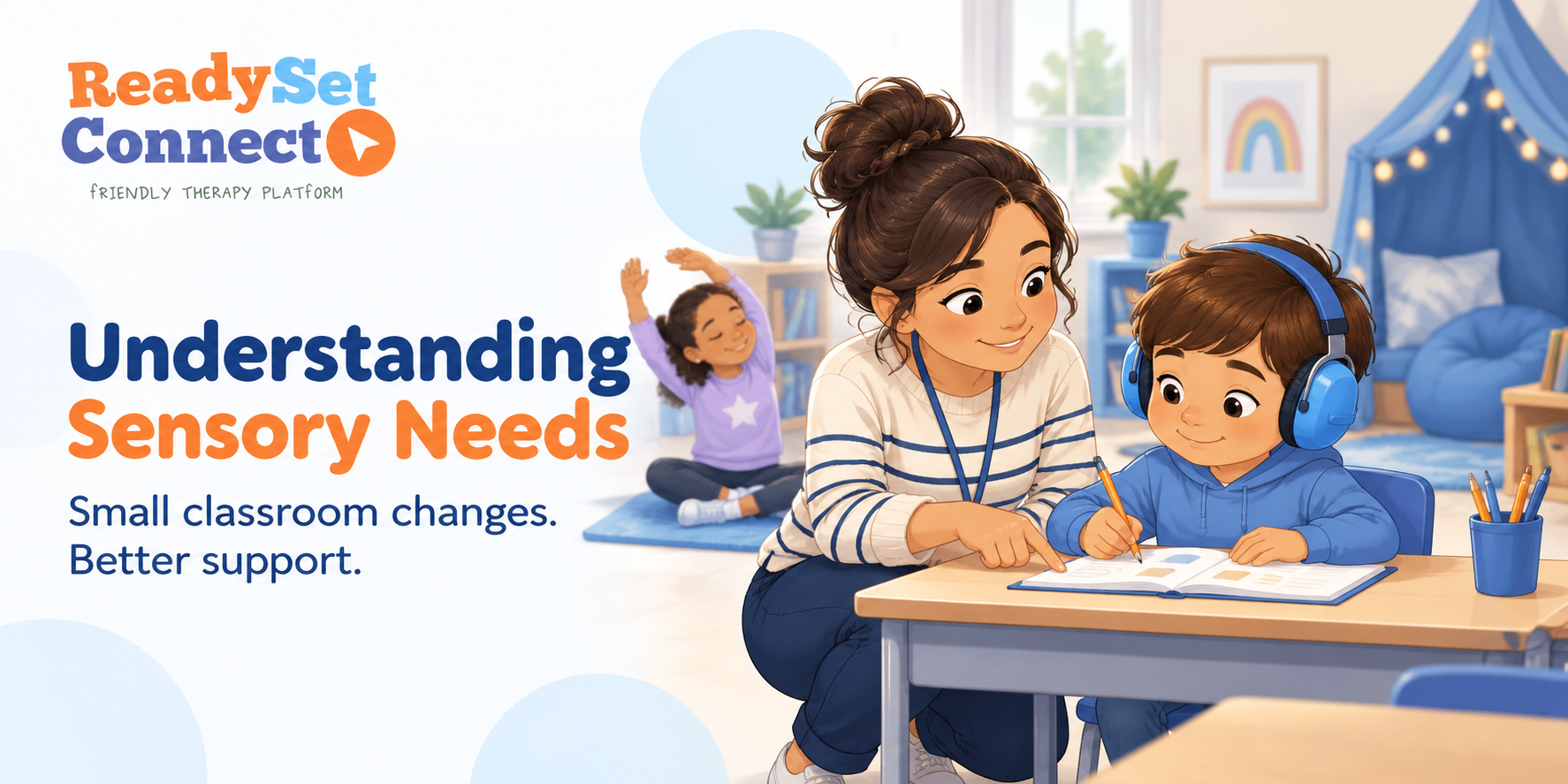
A few weeks into the school year, a teacher may start noticing small changes that are hard to explain.
One student covers her ears during a school assembly. Another leaves his seat every few minutes. A child who managed well last spring now becomes distressed after lunch and has difficulty getting back on track.
At first, these moments may simply look like behavior. But what if they are signals that a child is having difficulty managing the sensory demands of the school day?
For occupational therapists, these patterns can offer important clues about sensory processing and regulation. The sights, sounds, movement, transitions, and routines of a classroom can place significant demands on a child’s sensory systems, and some students may need additional support to stay regulated and ready to learn.
This guide explains what sensory processing means, why sensory processing difficulties may become more noticeable in the fall, and which sensory strategies for the classroom are practical for teachers. It also outlines when a formal occupational therapy evaluation may be worth requesting.
What Sensory Processing Is, and What It Is Not
Sensory processing refers to how the nervous system receives, modulates, organizes, and responds to sensory information from the body and the environment. This includes the five familiar senses and three less widely recognized systems:
- Vestibular: movement, balance, and spatial orientation
- Proprioceptive: awareness of body position, movement, and force
- Interoceptive: awareness of internal bodily signals, such as hunger, thirst, and the need to use the bathroom
Sensory preferences and responses vary among individuals. They become clinically relevant when they consistently affect a child’s participation in occupations and everyday activities, including learning, self-care, play, and social interaction.
Precise terminology matters. Although “sensory processing disorder” is widely used, it is not a standalone diagnosis in the DSM-5-TR, and the American Academy of Pediatrics has advised caution in using it as a diagnosis. Sensory processing differences are frequently observed alongside autism and ADHD, although their presence alone does not establish either condition.
For clinicians, the focus should be on understanding how sensory processing patterns relate to a child’s functional performance, participation, and individual support needs.
Why Sensory Regulation in the Classroom Is Harder in the Fall
The first weeks of school bring new demands and changes to familiar routines, often increasing students’ sensory load.
- Noise and crowding: cafeterias, hallways, gymnasiums, and assemblies
- Visual input: bright lighting, decorated walls, and busy displays
- Sustained sitting: longer periods of seated work and fewer movement opportunities
- Unpredictability: new schedules, unfamiliar adults, substitute teachers, and fire drills
- Physical changes: new shoes, uniforms, or unfamiliar clothing textures
Each demand may be manageable on its own, but their cumulative effect can make self-regulation more challenging. A student may manage throughout the school day yet have difficulty regulating emotions and behavior at home, where they feel safe enough to release the effort of coping.
For many students, these challenges ease as routines become familiar. When difficulties persist and interfere with participation, further assessment may help identify the underlying factors and appropriate supports.
Signs of Sensory Processing Differences in Children
Occupational therapists may describe sensory response patterns in terms of over-responsivity, under-responsivity, and sensory seeking. A child may demonstrate more than one pattern, and responses can vary across sensory systems and contexts.
| Sensory Pattern | What teachers and parents may observe |
|---|---|
| Sensory Over-responsivity | Covers ears or avoids noisy environments; becomes distressed during fire drills or assemblies; avoids messy play or certain textures; reacts strongly to unexpected touch; is bothered by clothing seams or tags. |
| Sensory Under-responsivity | Shows reduced or delayed responses to some sensory cues; may not consistently notice their name being called or changes in the environment; may appear unaware of food on their face. |
| Sensory Seeking | Frequently seeks movement or tactile input; rocks or moves in their chair; chews pencils or clothing; frequently touches objects or peers; seeks jumping, crashing, or activities involving deep pressure. |
These behaviors are not specific to sensory processing differences and may have multiple contributing factors, including attention, anxiety, communication difficulties, sleep disturbances, or vision and hearing impairments.
No single behavior is sufficient to identify a sensory processing difficulty. Clinical interpretation requires considering patterns of responses across contexts, their consistency over time, their impact on functional performance and participation, and other potential contributing factors.
Five Classroom-Ready Sensory Strategies an OT Can Share with Teachers
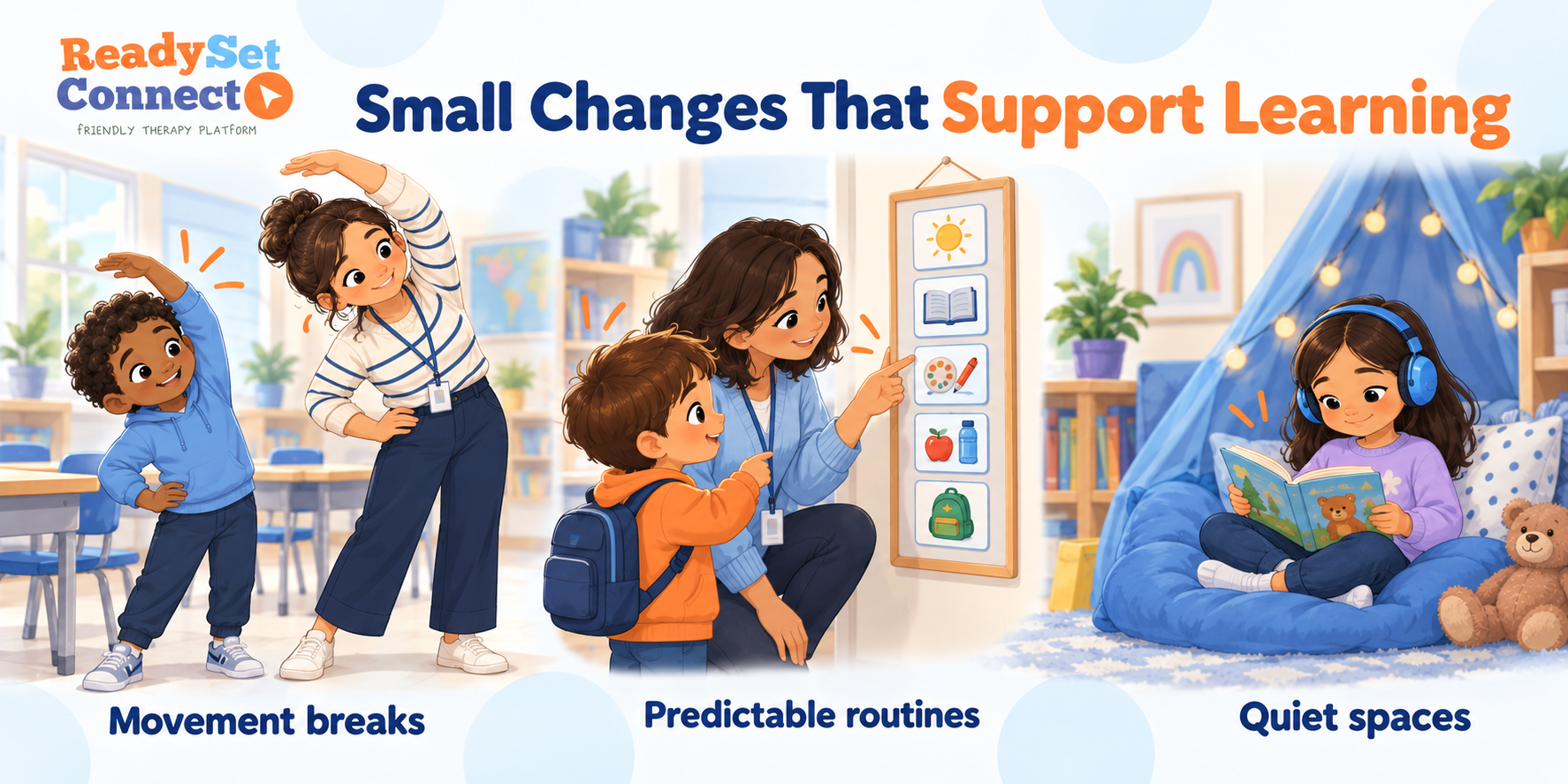
These strategies can support classroom participation and are often suitable for the whole class. They do not require a sensory-related diagnosis, but should be adapted to students’ individual needs.
- Plan movement opportunities. Offer brief movement breaks before or between sustained seated tasks. Stretching, wall push-ups, or carrying classroom materials can provide movement and proprioceptive input. Observe whether each activity supports the student’s engagement and participation.
- Reduce unnecessary sensory demands. Consider seating away from distracting noise or high-traffic areas, reducing visual clutter, and preparing students for predictable loud events. Noise-reducing headphones may help during specific activities when safe and appropriate, but should not routinely replace participation or access to instruction.
- Make transitions predictable. Use visual schedules, warnings, and consistent routines to help students anticipate changes. Where appropriate, offer choices such as moving at the beginning or end of the line.
- Provide a space for regulation. A quiet area can offer an opportunity to pause and regroup when overwhelmed. Introduce it positively, teach students how to use it, and plan how they can return to learning without stigma or punishment.
- Use seating options and tools purposefully. Standing desks, movement cushions, or fidget tools may benefit some students but not others. Identify the intended functional goal, establish clear expectations, and monitor whether the tool improves participation without distracting the student or classmates.
A note on evidence: Evidence for individual sensory-based interventions and tools varies, and findings for some approaches, including weighted vests, are limited or inconsistent. Introduce changes thoughtfully, monitor meaningful outcomes, such as engagement, task completion, or participation, and adjust or discontinue strategies that do not provide a clear benefit.
When to Request an OT Evaluation at School
Classroom strategies can be a useful first step, but persistent difficulties may warrant an individual occupational therapy (OT) evaluation. Consider requesting an evaluation when:
- Difficulties persist despite classroom supports, or concerns warrant earlier assessment.
- Sensory, motor, or self-regulation challenges interfere with learning, self-care, play, or peer relationships.
- Difficulties occur across settings, or the child’s needs remain significant in the school environment.
- The student experiences frequent distress or has difficulties affecting participation or safety.
In the United States, parents can request an evaluation through their school district. Procedures vary by state and district, so a written request can help document the concerns and the date of the request. Under the Individuals with Disabilities Education Act (IDEA), occupational therapy is a related service when required to help an eligible student benefit from special education.
Students who do not qualify for an Individualized Education Program (IEP) may still qualify for services or accommodations under Section 504, depending on whether they meet its disability criteria and need related support.
School-based OT evaluations examine functional performance and educational participation. A medical diagnosis is not required to request an evaluation, and a diagnosis alone does not guarantee eligibility for school-based services. Depending on the concerns, consultation with a pediatrician or another healthcare professional may also help identify contributing factors, including hearing, vision, or other medical concerns.
What a Sensory Profile Assessment Involves
An OT evaluation may combine observations, teacher and caregiver interviews, and standardized questionnaires to understand how sensory processing relates to a child’s everyday functioning. One commonly used tool is the Sensory Profile 2, which includes caregiver questionnaires and a School Companion form for teachers of students aged 3 years to 14 years, 11 months.
The Sensory Profile 2 describes four patterns of sensory processing: Seeking, Avoiding, Sensitivity, and Registration (often referred to as low registration). These patterns help clinicians understand how a child responds to sensory experiences across everyday contexts. The profile is not a diagnosis and should be interpreted alongside other assessment findings to guide individualized supports.
Frequently Asked Questions
Is sensory processing disorder an official diagnosis?
Sensory processing disorder is not recognized as a standalone diagnosis in the DSM-5-TR. However, sensory differences are well documented and may occur alongside conditions such as autism and ADHD. The diagnostic features of autism also include sensory hyperreactivity or hyporeactivity and unusual sensory interests. Occupational therapists can assess and address how these differences affect everyday activities, regardless of whether a formal diagnosis is present.
How long should a sensory break last?
Often, a few minutes is a reasonable starting point, but the duration should depend on the student’s needs and response. The key measure is whether the break supports a return to participation. If a break consistently leaves a student more unsettled or does not improve engagement, its timing, duration, or activity may need to be adjusted.
Does my child need a diagnosis to receive OT at school?
Not necessarily. In the United States, school-based OT eligibility depends on the applicable educational eligibility criteria and whether the service is needed to support the student’s access to and participation in education. A medical diagnosis alone does not guarantee eligibility.
Learn More About Sensory Profiles
Sensory differences in the classroom are common, particularly during periods of transition such as the start of the school year. Thoughtful adjustments may support participation. When difficulties persist, an occupational therapy evaluation can help identify individual needs and appropriate supports.
Clinicians, educators, and parents who want to build a stronger foundation can browse the sensory processing course, The Basics of Sensory Processing and Understanding Sensory Profiles, an on-demand webinar taught by occupational therapist Jacqui Jorge. It covers sensory profiles, strategies to consider or avoid, and how sensory input may influence arousal and regulation.
ReadySetConnect also supports occupational therapists and school-based teams with documentation and progress tracking. Explore additional courses in the education and webinar library.