
Every therapy practice is familiar with the impact of an empty appointment slot. When a ten o’clock appointment is missed, the consequences extend beyond lost revenue: a clinician’s time goes unused, a child misses a session that may be important to their plan of care, and another family loses an opportunity to access care. A single no-show may seem minor, but when missed appointments become a recurring pattern, they can steadily erode both clinical capacity and practice revenue.
The good news is that no-shows are one of the most fixable problems you have, and most of the fix comes down to how you set up your schedule. This is a practical guide to the setup that keeps chairs full: automated reminders, recurring sessions, a cancellation plan that actually works, and the small calendar habits that separate low-no-show practices from the rest. Everything here can be set up inside the scheduling tools in ReadySetConnect.
Start with automated reminders
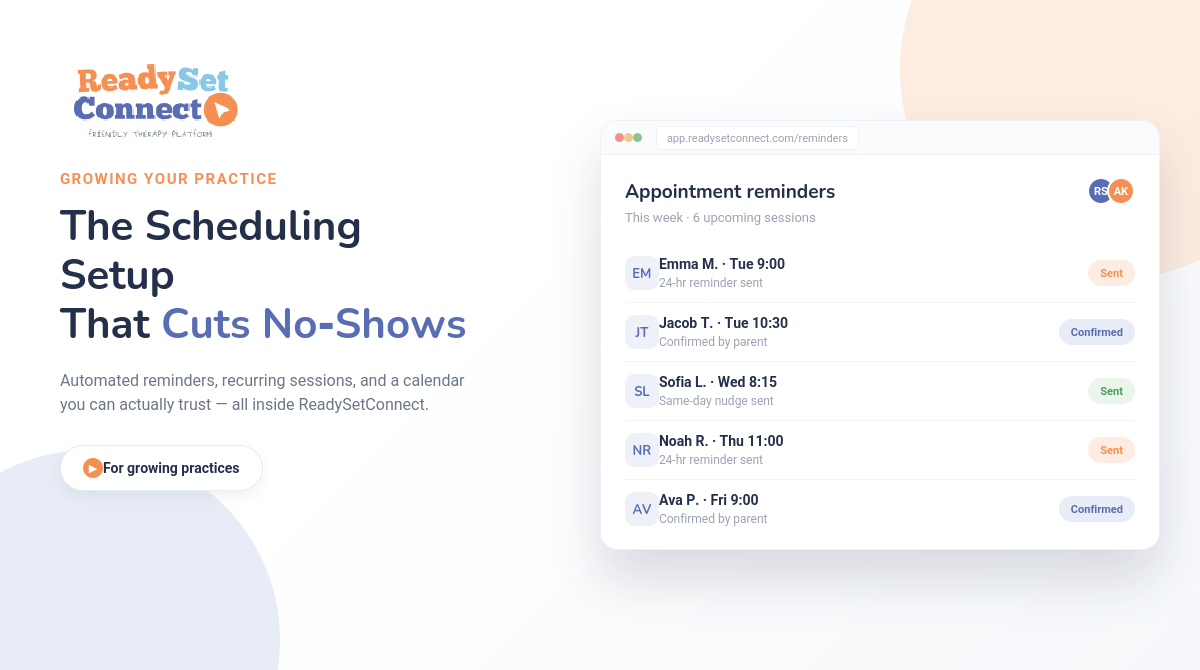
If you do only one thing, do this. Automated appointment reminders are the single biggest lever you have against no-shows, and they work because most missed sessions are not defiance. They are simply forgotten. A parent juggling work, siblings, and three other appointments is not skipping on purpose. A well-timed reminder meets them where they are.
A few things make reminders work harder:
- Timing. A reminder around 24 hours out gives a family time to plan, and a shorter same-day nudge catches the ones who need it on the morning of. The combination beats a single message.
- A clear ask. The best reminders make confirming or rescheduling easy, so a parent who cannot make it can tell you now rather than simply not turning up.
- The right channel. Meet families where they actually read their messages, not where it is most convenient for you to send.
Set reminders once, apply them across your calendar, and you have removed the most common cause of a missed session before it ever happens.
Use recurring session blocks
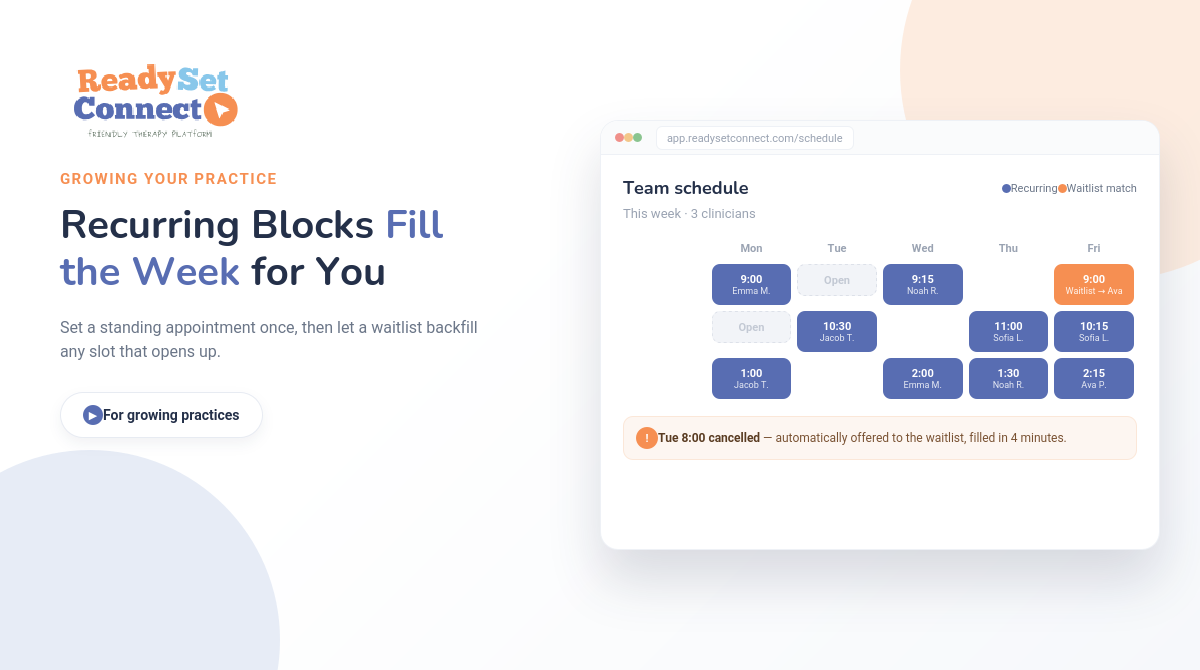
Pediatric therapy runs on consistency. A child who sees you at the same time every week builds a routine, and routine is what keeps families showing up. Recurring session blocks turn that consistency into your default, instead of something you rebook by hand every week.
Standing appointments do two jobs at once. They protect the family’s slot, which reassures parents that their time is held, and they protect your calendar from the gaps that appear when every booking is one-off.
Set the recurring block once and the week fills itself. When a family needs to pause or move, you adjust the series rather than rebuilding it from scratch.
For a growing caseload, this is also how you stay in control of your capacity. Recurring blocks make it obvious at a glance where you have room and where you are full.
Handle cancellations on purpose
Cancellations are an inevitable part of running a therapy practice. What distinguishes a practice that can absorb them from one that continually loses revenue and clinical capacity is how intentionally those cancellations are managed. Three key components can make cancellations more predictable, manageable, and less disruptive:
- A clear policy. Families respect a cancellation window when they know it exists. State it plainly at intake and hold to it.
- Easy rescheduling. A cancelled session you rebook is not a lost session. Make it simple for a family to move to another slot rather than disappearing altogether.
- A way to backfill. When a slot opens, a short waitlist or a quick message to a family hoping for an earlier time turns a hole in your day into a filled hour.
Handled this way, a cancellation becomes a scheduling task, not lost revenue
The calendar habits of low-no-show practices
Beyond the tools, the practices with the lowest no-show rates tend to share a few habits:
- They confirm proactively. A quick confirmation routine early in the week catches problems while there is still time to fill the slot.
- They track the number. You cannot improve a no-show rate you do not measure. Watching it month to month tells you whether your setup is working.
- They build in buffers. A little breathing room between sessions keeps a single late arrival from cascading through the whole afternoon.
- They book the next session before the family leaves. Scheduling the next appointment at the end of the current one is the simplest retention habit there is.
None of these are dramatic. Together they are the difference between a calendar you fight and one that mostly runs itself.
Consistency is a clinical result, not just an admin win
It is easy to view no-shows as an operational issue, but a missed session is also a clinical event. Therapy relies on consistency and repetition, and every plan of care is built on the expectation that the child will attend regularly. Each missed session can interrupt momentum, delay progress toward established goals, and make outcome data more difficult to interpret for both families and insurers. Protecting attendance, therefore, is about more than safeguarding revenue. It is about protecting the clinical outcomes clients seek, supporting sustained progress, and maintaining the continuity of care that keeps families engaged over time.
Your quick setup checklist, in order: turn on automated reminders (a 24-hour and a same-day), set recurring blocks for your regular clients, write and share a simple cancellation policy, start a waitlist to backfill openings, and check your no-show rate once a month. Work down that list, and most of your missed sessions disappear.
If you are still getting your bearings on the platform, our quick-start setup guide walks through the basics of setting up your account and calendar for the first time. Once the foundation is in place, the scheduling habits above are what keep it running.
No-shows feel like something that happens to a practice. In reality, they are mostly a setup problem, and a setup problem is one you can solve. Reliable reminders, standing appointments, and a calendar you actually trust give your clients the consistency their progress depends on, and give you back the hours you worked hard to fill.
Frequently asked questions
What counts as a good no-show rate for a therapy practice?
There is no single number, and it varies by setting and population, but many practices aim to keep no-shows in the single digits. The most useful benchmark is your own: track your rate, then work to bring it down month over month.
How far in advance should appointment reminders go out?
A pairing works best. A reminder about 24 hours ahead gives families time to plan around the appointment, and a shorter same-day nudge catches anyone who needs the prompt on the morning of the session.
Do automated reminders really reduce no-shows?
Yes, because most missed sessions come from forgetfulness rather than intent. A timely, easy-to-act-on reminder removes the most common reason families do not show and gives them a simple way to reschedule if they cannot make it.
How do recurring sessions help with no-shows?
Recurring blocks give a child a consistent routine and hold the family’s slot each week. Predictable, protected appointments are easier for families to build their week around, which means fewer forgotten or dropped sessions.
Can I set all of this up myself in ReadySetConnect?
Yes. Automated reminders, recurring session blocks, and cancellation handling are all part of the scheduling tools, so you can put the whole setup in place without extra software.
Ready to cut your no-shows? Set up automated reminders and recurring sessions in ReadySetConnect. Try the scheduling tools for free.